TL;DR
- The quick definition: AI visibility is how often and how accurately a brand gets mentioned and cited when tools like ChatGPT, Gemini and Google AI Overviews answer people’s questions.
- What this guide covers: the plain definition, mentions versus citations, how AI visibility differs from SEO and GEO, how AI picks sources, how to measure it, how to improve it and the most common mistakes to avoid.
- Visibility is earned by being mentioned and cited across the web, not by ranking one page. Being well understood matters more than being well ranked.
- Before buying any tool: run the free 10-minute check below across ChatGPT, Gemini and Perplexity to see where a brand actually stands.
AI visibility sounds like another term the marketing world minted to sell dashboards and half the articles defining it prove the point.
But look at where buying decisions happen now: a buyer asks ChatGPT for the best option and the model hands back a short list of names. If a brand is on that list, it wins the moment. If it is not, it never gets considered.
That is what “what is AI visibility” is really asking about. Find out everything you need to know below.
The true meaning of AI visibility
AI visibility is how often, how accurately and how prominently a brand shows up when AI tools answer a question. When someone asks an AI assistant about your category, do you get named, described correctly and cited as a source, or do you get skipped? That is the whole idea.
Think of it as four things stacked together:
- Frequency: how often you appear across the questions your buyers ask.
- Accuracy: whether the AI describes you correctly when it does mention you.
- Prominence: whether you are the headline answer or a footnote near the bottom.
- Attribution: whether the answer links back to you as a source.
Here is the plain version. Search used to hand people ten blue links and let them choose. AI tools skip that step. They read the web, form an opinion and give one answer. AI visibility measures whether your brand is inside that answer.
The old question was “does this page rank?” The new one is “does the AI recommend me?” Those are not the same, as a brand can win the first while quietly losing the second.
That shift is why the term matters at all. Ranking gets you onto the shelf, but AI visibility decides whether you are the thing the assistant picks up and hands to the customer. Brands used to worry about position; now, they worry about representation…
Being present, being right and being chosen are three separate battles. Most brands have only ever fought the first one. The rest of this guide is about the other two.
What AI visibility is not
A few things get filed under AI visibility despite not belonging there. Clearing them up saves a lot of wasted effort, so here’s what AI visibility is not:
- It is not your Google ranking with a new coat of paint. You can rank first for a term and still be missing from the AI answer built on top of it. The two get measured differently and are won by different types of work.
- It is not the same as brand awareness or a big social following. Plenty of famous brands get described badly by AI and plenty of small ones get described well. What matters is how the model understands you, not how many people already do.
- It is not a one-time setup. Models change, answers drift and competitors keep pushing. Visibility is a position you hold, not a box you tick once.
Remember what we discussed above? AI visibility is about being present, accurate and cited inside AI answers. Anything that does not move one of those three is a different project wearing the same name.
Citations and mentions: the two sides of AI visibility
AI visibility shows up in two forms, and mixing them up leads to bad decisions:
- A mention is when the answer names your brand in the text.
- A citation is when the answer links to your site as a source.
They look similar, but they’re not. Here’s why:
- A mention shapes what the reader thinks, while a citation sends a click and signals that the model treats you as evidence.
- You can be mentioned without being cited. The AI calls your brand a strong option but links someone else as the source.
- You can also be cited without being the recommendation. Even though your page feeds the answer, a competitor gets named as the pick anyway.
Here’s how you can test this by yourself: just ask an assistant for the “best CRM for a small team” (or any similar prompt) and see how it might praise one brand in the text while linking a review site as the source. It’s very, very common!
And yes, that gap matters because most people never click the links, as shown by Pew Research:
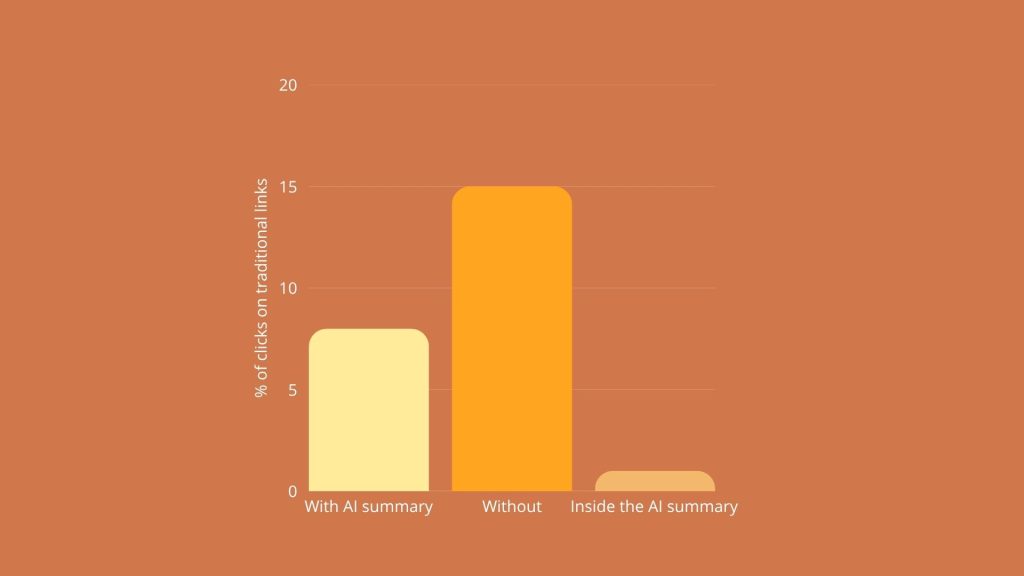
On pages that showed a Google AI summary, users clicked a source inside that summary in just 1% of visits. Therefore, the mention often does more work than the citation. Influence beats the click.
Accuracy sits on top of both. After all, an AI can mention you and get you wrong, and that’s actually worse than being ignored. Confident, wrong descriptions travel fast and shape opinions before anyone checks. It’s not just a question of “am I being cited?” but also of “how am I being cited?”.
Why AI visibility matters NOW
ChatGPT passed 800 million weekly active users in late 2025; Google AI Overviews reached more than 2 billion monthly users around the same time; Perplexity’s chief executive said the tool handled 780 million queries in a single month. We could keep on going, but the point here is that these tools are not fringe products anymore.
They sit between your buyers and their choices. When one of them summarizes your category and names three tools, those three get the consideration. Everyone else is competing for a click that increasingly never comes. But the behavior around those answers is the real story…
Consider the graph above and compare the percentage of clicks in answers with versus without an AI summary: as you can see, clicks drop by almost a third when a summary is present. There are fewer clicks and more dead ends, and that’s why appearing in the answer is quickly becoming the end goal.
Picture a concrete case:
- A marketing lead needs a tool and asks ChatGPT “what is the best way to track how AI describes a brand”
- The model names three products and explains why
- The lead opens two of them and buys one that week
No Google search happened and no results page got scanned. The AI answer was the entire funnel and this is by no means an exceptional case.
There is a trust transfer underneath this too. People treat the AI’s short list the way they used to treat a recommendation from a friend. It feels vetted, even when nobody checked. Did you know, for example, that teachers are more likely to trust AI than humans?
This is why AI strategic visibility moved from a curiosity to a line item. It is not about chasing a shiny new channel but rather about staying in the room where the decision gets made.
The honest caveat is that AI referral traffic is still small next to Google search. Nevertheless, small and growing fast is the moment to pay attention, not the moment to wait. The brands building visibility now become the defaults the models reach for later.
Who should care about AI visibility
Things are definitively changing, but not every brand needs to obsess over this yet. Some, on the other hand, should have started a year ago… So, which one are you?
The test is simple. Do your buyers ask AI tools questions that your brand could answer?
B2B software is the clearest case. Buyers research tools by asking AI for shortlists and comparisons, so being named in those answers is close to being on the demo list. Miss the shortlist and you never get the meeting…
E-commerce and consumer brands are next. Shoppers ask AI for product picks, gift ideas and “best X under Y” answers. A brand that never surfaces in those replies loses discovery it used to win through search.
Local and service businesses feel it in a different shape. People ask for the best option in their city or the right pro for a job and the AI answers with a handful of names. Consistent, accurate business information decides whether you are one of them.
Publishers and creators sit in the toughest spot. Their traffic depends on the click, and AI answers absorb the click. For them, being the cited source is not a nice-to-have; it is the business model under pressure.
If your category shows up in AI answers at all, you are already being ranked by these tools. The only question is whether you know your standing or are guessing.
How AI visibility differs from SEO
SEO earns a ranked spot in a list of links and lets the user choose. AI visibility earns a place inside a single answer, where the AI has already chosen. One is about position. The other is about representation.
First, let’s take a closer look at the differences:
| Dimension | Traditional SEO | AI visibility |
|---|---|---|
| The unit | A ranked page in a list of links | A place inside one generated answer |
| What you win | A position from 1 to 10 | A mention, a citation or the recommendation |
| Main signal | Backlinks and on-page relevance | Being mentioned and cited across trusted sources |
| How you check | Rank trackers and fixed positions | Run prompt sets repeatedly and count the outcomes |
| The output | A blue link the user clicks | An answer the user often never clicks past |
The stuff that carries over, on the other hand, is crawlable content, real authority, clean information and clear entities. If AI cannot read you, it cannot cite you.
So, what’s really new is the volatility. There is no fixed rank to check. Even if you’re asking the exact same question, the answer can change. Visibility is a distribution, not a position, which is why one lucky result tells you nothing.
The other shift is where the work lives. SEO rewards your own pages, while AI visibility rewards what the rest of the web says about you.
Being mentioned in the sources the model trusts often does more than any single page you publish. That’s why you should treat AI visibility as the next layer, not the replacement. Good SEO is no longer the finish line… but it remains the foundation.
You can learn more about the new role of SEO by reading our SEO vs GEO and AEO guides, both of which explore concepts closely related to AI visibility.
How AI visibility relates to GEO and AEO
AI visibility is the outcome, the thing you want. GEO and AEO are the practices you use to earn it. If AI visibility is scoring goals, then GEO and AEO are playing nice football.
GEO stands for Generative Engine Optimization. This is the most official term because it came from an actual research paper that showed that specific content changes, such as adding sources and quotes, could lift a source’s visibility in generated answers by up to 40%:
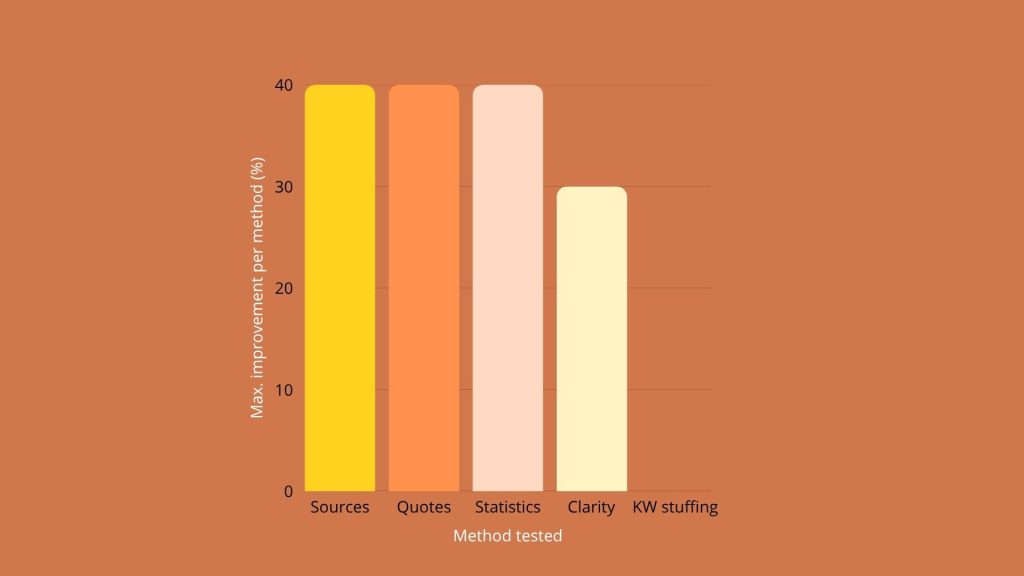
AEO stands for Answer Engine Optimization. It usually means the narrower work of earning the direct citation inside an answer, but people actually use GEO and AEO interchangeably, so don’t worry too much about the technical details (if you are actually interested in these, please check our detailed article on AEO vs GEO).
More than the acronyms, what matters here is their relationship to AI visibility. AEO and GEO are the input; visibility is the scoreboard.
How AI systems decide what to surface and cite
To improve AI visibility, you have to know how the answer gets built. There are two mechanisms behind almost every AI answer (training data and live retrieval) and they reward different things.
Training data versus live retrieval
- Training data: the model absorbed a huge slice of the web during training, so it already carries impressions of brands, products and categories. If you were widely and consistently described across that data, the model knows you.
- Live retrieval (often called grounding): here the system does not answer from memory; it runs a search, pulls current pages, feeds them to the model and returns an answer with inline links. Google describes this in its grounding documentation.
The difference shows up in practice:
- Ask about a brand that launched last month, and a memory-only answer may not know it exists.
- Ask a tool that searches live, and a fresh, well-structured page can appear within days.
New brands lean on retrieval, while established ones bank on both. But here’s the blunt practical takeaway: to appear in a grounded answer, you have to be in the set of pages the system can find and trust when it searches. To appear in a memory answer, you had to be described well across the web long before the question got asked.
The signals that actually move the needle
So, what are the signals that actually matter? The most striking evidence comes from an Ahrefs study of 75,000 brands. The study determined that branded web mentions correlated with AI Overview visibility far more strongly than backlinks did (0.664 against 0.218):
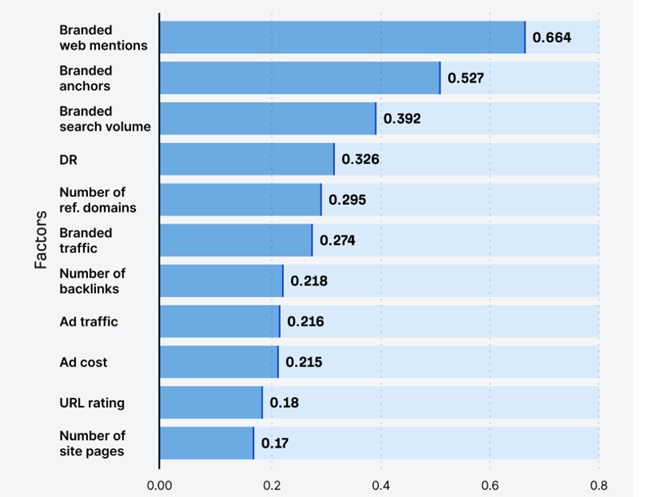
The same study found 26% of brands had zero AI Overview mentions at all.
Read that again, because it reorders the priority list! Being talked about across the web mattered more than the classic backlink. Mentions, not just links, are what feed the machine.
The signals that follow are not exotic. They are the familiar trust markers, pointed at a new kind of reader:
- Clear, consistent facts about who you are.
- Third-party authority, meaning other trusted sites describe you.
- Content structured so a model can lift a clean answer.
- Freshness, so retrieval finds something current.
Entities tie everything together. The model needs to understand what your brand is, what category it sits in and what it is known for.
Take, for example, a project tool that is described as a CRM on one site and a docs app on another. That brand has a blurry entity, so the model hedges or skips it.
A brand with one consistent story across the web is easy to place and easy to name. Fuzzy identity produces fuzzy answers, and fuzzy answers rarely name you. You can learn more about this on our LLM optimization guide.
How AI visibility is measured
Evidently, you cannot open a report and read your AI rank when there is no rank. Therefore, measurement works differently. This is the new process: you pick the questions that matter, ask them across the AI tools repeatedly and count what comes back.
That means AI visibility measurement is really about a prompt set. Define the real questions your buyers ask, run each one across ChatGPT, Gemini, Perplexity and others and then log the outcomes. Repeat the loop enough times, and you start to see a pattern.
The metrics that matter
A handful of metrics carry most of the weight:
| Metric | What it answers | How it is counted |
|---|---|---|
| Presence or visibility score | How often you show up at all | Share of tracked prompts where you appear |
| Share of voice | How you stack up against rivals | Your mentions against competitors’ across the set |
| Citation rate | How often you are the linked source | Share of answers that cite your site |
| Mention rate | How often you are named in the text | Share of answers naming your brand |
| Sentiment and accuracy | Whether the AI describes you right | Positive, neutral or wrong, scored per mention |
| Recommendation rate | How often you are the actual pick | Share of answers that recommend you |
When you put these metrics together, you get what most tools mean by AI visibility tracking. A visibility score tells you presence, share of voice tells you standing and citation/recommendation rates tell you whether presence turns into a real advantage.
How to read these numbers
Do not chase a single vanity figure. A high mention rate with poor sentiment means the AI talks about you and gets you wrong, while a strong citation rate with a weak recommendation rate means you feed answers that name someone else. So, read them together.
Say your visibility score is high but your recommendation rate is low. That pattern means the AI knows you exist and still points buyers elsewhere, which is a positioning problem, not an awareness one.
The reason to measure at all is that buyers act on these answers. A Boston Consulting Group survey found 66% of consumers use generative AI at least weekly for shopping-related tasks. If two-thirds of your buyers ask an AI during the journey, the AI’s opinion of you stops being a curiosity; it becomes an essential business metric.
So, what counts as good? Honestly, it is relative, as there is no universal pass mark for an AI visibility score.
A useful target is being named more often than your direct rivals for the questions that drive revenue, with accurate descriptions and a rising trend. Beat your competitors on the prompts that matter, and move the line up over time.
Why AI visibility numbers are only estimates
Here is the catch nobody selling a dashboard leads with: every AI visibility number is an estimate. Treat anyone who says otherwise with caution.
The reason is structural: not even the best AI visibility tools see the true volume of prompts people type into ChatGPT or Gemini. Instead, they run their own synthetic prompts and sample the answers. That is a smart proxy, sure, but no proxy is ever a census.
Answers also vary run to run, and models change under you without warning. A score that looks precise to the decimal is really a snapshot of a moving target.
You can watch this in the public data. According to Search Engine Land, estimates of how many Google searches even trigger an AI Overview swing wildly by method, from roughly 48% in one tracker down to the mid-teens in another across 2025. When the trackers disagree by that much, a single confident percentage is a red flag.
The solution is to use the numbers the right way. Track direction and relative position, not absolutes:
- Is your share of voice climbing against rivals?
- Are accurate mentions growing?
Those trends hold up even when the exact figure is soft. A tool that admits the fuzziness is more honest than one that hides it. The point of measurement is decisions, not decimals.
How to check your AI visibility for free
Before spending a cent on software, run a manual check. It takes about ten minutes and tells you more than most first-time buyers expect.
Start by writing down the real questions your buyers ask. That’s not your brand name, but category questions such as “best tool for X” or “how to fix Y.” Then work through them using this loop:
- Run each question in ChatGPT, Gemini and Perplexity.
- Ask each one two or three times (a single answer is noise).
- Note whether you get mentioned, whether you get cited with a link and whether the description is accurate.
- Write down which competitors show up and how often.
What you learn is immediate. You see whether the AI knows you, whether it recommends you and whether it gets you right. You also see who it favors instead.
This manual pass is the honest baseline before any tool. If the free check already shows you missing from every answer, no dashboard changes that. The work does and software just measures it at scale once you commit. If you need more, check out CrowdReply’s free AI visibility checker.
How to improve your AI visibility in 4 steps
Improving AI visibility comes down to one idea: becoming the brand the model understands clearly and trusts enough to cite. Everything below serves that.
1. Fix your entity foundation first
Start with identity. The model needs to know exactly what you are, what category you sit in and what you are known for. Inconsistent facts across the web produce vague, wrong answers.
Make the basics airtight. Consistent brand facts everywhere, a clear About page, and structured data that spells out who you are. This is unglamorous work, sure, but it is also where most of the early gains hide.
If your homepage, your LinkedIn and a directory each describe your product differently, just pick one description and make all three match. That single cleanup often lifts how confidently the AI can name you.
2. Earn mentions and third-party authority
This is the lever the Ahrefs data pointed at. Being mentioned across trusted sites moved AI Overview visibility more than backlinks did. So the priority is being talked about accurately in the places the model reads.
Think digital PR, guest features and being included in the roundups and comparison pieces for your category. Getting named in credible discussions counts too. When the AI reads about your category, your name should keep appearing.
A practical move is to find every “best tools for X” article in your space and work to be listed in them. Those are exactly the pages models pull from when they build a shortlist.
3. Publish content a model can actually cite
Write for extraction. Put clear answers near the top, add real statistics and expert quotes and format so a model can lift the point without guessing. Pages that answer a question directly get pulled into answers.
Pages that bury the point get skipped. Structure is not decoration here. A well-formatted answer is easier to cite than a brilliant paragraph hidden in a wall of text.
One habit helps more than any clever trick: answer the exact question in the first two sentences of a section before adding the long explanation underneath. Models grab that opening answer… and impatient readers do too!
4. Keep it fresh and let the crawlers in
Freshness feeds retrieval. Updated pages are more likely to be pulled into a live answer than stale ones, so revisit your core pages instead of letting them rot.
Then check your gates. If your robots rules or llms.txt block the AI crawlers, you are invisible by your own hand. Make sure the bots you want in can actually get in.
Do this AI visibility optimization work consistently and the metrics should follow.
The stakes are real, by the way: Gartner predicted in early 2024 that traditional search volume could fall 25% by 2026 as people shift to AI assistants. And while that exact drop looks overstated in hindsight, the direction is not in doubt.
The AI visibility maturity curve
Visibility is a ladder, not a switch. Brands climb it in stages, so knowing your rung tells you what to fix next. These are the five stages of AI visibility:
- Extractable: the AI can even read and parse your pages.
- Mentioned: your name shows up in answers about your category.
- Cited: the AI links to you as a source.
- Recommended: the AI names you as the pick, not just a name in a list.
- Defended: you hold that spot and get it right, run after run.
Most brands sit lower than they think. Remember that a quarter of the brands in the Ahrefs study had zero AI Overview mentions at all! Plenty are stuck at extractable and readable but never surfaced.
The point of the ladder is focus. If you are not being mentioned, earning citations is the wrong goal this quarter. Climb one rung at a time and match the work to where you actually stand. Unfortunately, you can’t be defended without being recommended, being recommended without being cited, and so forth.
So, use these five stages “maturity” as a to-do list:
- If pages are not even extractable, fix structure and crawler access first.
- If you are mentioned but never cited, tighten the content so it is worth linking.
- If you are cited but rarely recommended, the gap is reputation, and that gets earned off your own site.
Common mistakes that quietly kill AI visibility
Some brands sabotage themselves without knowing it… The good news is that some of the most common mistakes can be easily avoided. Here’s a rundown:
- Blocking AI crawlers: This is the biggest own goal. Cut off the bots and you cut off every answer they build. Plenty of brands do this by accident and wonder why they never appear.
- Inconsistent brand facts: If your details differ across the web, the model gets confused and either skips you or describes you wrong.
- Thin, unstructured content: This is a quiet killer. If a page never answers the question plainly, there is nothing clean for a model to lift.
- Chasing rank while ignoring off-site mentions: You can sit at position one and still be absent from the answer because the answer is built from what the whole web says, not just your page.
- Trusting a single good run: This one’s the main measurement mistake. Outputs vary, so one flattering answer is not a trend. Track the pattern, not the fluke.
- Ignoring accuracy: An AI that describes you wrong is doing damage while you celebrate the mention. Watch out for this one, as it’s worth catching early.
Getting ready for AI agents
There is a rung past being cited that is worth spotting early and that’s being ready for AI agents.
The shift is from assistants that answer to agents that act. An agent does not just describe options; it compares them, shortlists them and, increasingly, transacts on someone’s behalf.
For a brand, that raises the bar. An agent has to parse your information cleanly, pull accurate details and act without hitting a wall. Structured data and clean, machine-readable pages stop being nice-to-have.
APIs and clear product information become the difference between being usable and being skipped. The brands that are already extractable, accurate and structured for humans are most of the way there. The ones relying on vibes and pretty pages are not.
As agents take on more of the shortlisting, unreadable brands get filtered out before a person ever sees the choice. This is not a reason to panic or rebuild everything, but it’s more than enough reason to treat structure and accuracy as durable investments. Why? Essentially, because the same work that earns citations today makes you agent-ready tomorrow.
AI visibility versus brand monitoring
These two get sold together, so it helps to separate them:
- Brand monitoring watches what people say about you across social posts, reviews and news.
- AI visibility watches what the machines say about you inside AI answers.
The overlap is real, as both care about mentions and sentiment. The difference is the audience and the stakes:
Brand monitoring tracks human conversation you can often join and reply to.
AI visibility tracks a model’s synthesized opinion that shapes a buyer’s shortlist before you get a chance to respond.
One is a conversation, the other is a verdict and the reality is that you want both. Nevertheless, please don’t assume a social listening tool covers the AI side because most were built to read people, not models, and the signals live in different places.
Where AI visibility tools fit
Tools in this space do two very different jobs, and confusing them wastes money:
- Monitoring: Dashboards that track mentions, citations, share of voice and sentiment across the AI tools. This includes, for example, AI citation tracking tools and AI visibility metrics software.
- Action: Fixing entity data, earning mentions, and building the authority and content that move the number.
Monitoring shows the score; it does not raise it… That gap is the reason CrowdReply exists. We’ve built it to close the loop between seeing where AI gets your brand wrong and doing something about it. Since monitoring is now standard, the work of changing the answer is the harder, more valuable half.
Frequently asked questions
What is the difference between AI visibility and SEO?
SEO is about ranking a page in a list of links so a person can choose. AI visibility is about being mentioned and cited inside a single AI-generated answer, where the AI has already chosen. SEO rewards your own pages and backlinks, whereas AI visibility rewards what trusted sources across the web say about you.
Is AI visibility the same as GEO or AEO?
Not quite. AI visibility is the outcome you want. GEO, Generative Engine Optimization, and AEO, Answer Engine Optimization, are the practices you use to earn it.
What is a good AI visibility score?
There is no universal pass mark because every score is an estimate built from sampled prompts.
Can you track AI visibility for free?
Yes, and everyone should before paying. Write down the real questions your buyers ask, run each in ChatGPT, Gemini and Perplexity two or three times, and note whether you are mentioned, cited and described accurately. It takes about ten minutes and gives you an honest baseline.
Which AI platforms should you track?
Start with the ones your buyers actually use. For most brands that means ChatGPT, Google AI Overviews, Gemini, Perplexity and Claude. AI Overviews and ChatGPT reach the widest audiences, so they usually matter most.
How long does it take to improve AI visibility?
Fixing entity data and structure can show up in weeks. Earning the mentions and authority that move the number is a matter of months, as it depends on the wider web catching up.
Can AI visibility be improved, or is it decided by the algorithm?
It can absolutely be improved. The models decide the final answer but they build it from signals you control, your entity clarity, your third-party mentions, your structured content and your freshness. You do not program the model; you change what it reads about you, and the answer follows.