TL;DR
- CrowdReply is the best Otterly AI alternative for most teams because it is the one tool here that closes your AI visibility gaps instead of just charting them.
- Depending on your specific needs, Profound (best enterprise), AthenaHQ (model coverage) and Peec AI (agency reporting) can also be excellent Otterly alternatives.
- I went looking for an Otterly AI alternative because it helps you see the gap, not close it. Otterly’s $29 headline (its main strength) is also a bit of a mirage.
- What you can do right now: run your own brand through ChatGPT and Perplexity, then trial two tools on the exact same prompts for two weeks before you pay for anything.
I have been skeptical about AI visibility tools since the first one landed in my inbox. Most of them are the same dashboard wearing a different logo, and half the pricing pages want a sales call before they will tell you a number.
So when my own brand kept getting skipped in ChatGPT while a competitor got named in the answer, I stopped reading launch threads and started signing up. Otterly AI was one of the first tools I tried, mostly because it is the cheapest way into this category.
But while at first I found Otterly to be impressive, I quickly realized it wasn’t nearly as complete as I would like. So, I went looking for an alternative…
My method? Personally testing each of the 8 tools most posts cite as the “best Otterly AI alternatives”: CrowdReply, Profound, AthenaHQ, Pecc AI, Scrunch, Semrush’s AI Toolkit, Writesonic and Semrush’s Brand Radar.
Before diving into my test results, though, here’s what I like and don’t like about Otterly AI:
What Otterly AI gets right
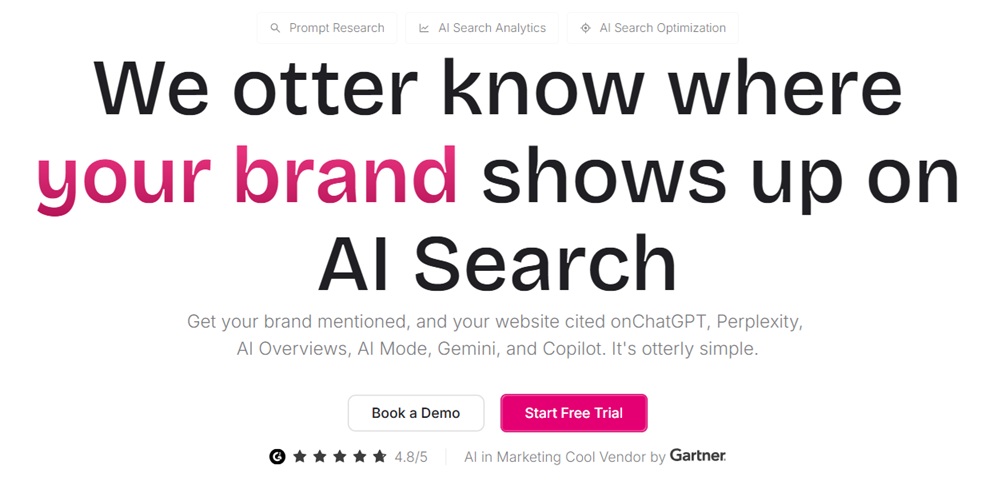
Otterly.AI is an AI search visibility monitor out of Austria that launched its tracking product in late 2024; it watches how your brand shows up across AI answer engines, tracks your mentions and citations and runs a GEO URL audit on top.
It’s a serious enterprise
It was built by three founders who had already built and sold SaaS tools like Usersnap and Storyblok, so this is not a weekend project. It is a real product from people who have shipped before.
It has real credibility
I am not going to bury it:
- Otterly AI was named a Gartner Cool Vendor for AI in Marketing in 2025, and
- It sits at 4.8 out of 5 on G2 as a High Performer for answer engine optimization.
Those are not nothing!
It’s very affordable
Otterly AI is the cheapest real way into AI mention tracking and the pricing is published in plain sight, which I appreciate more every time a competitor makes me book a demo just to learn a number.
Every plan comes with unlimited team members, daily tracking and a detailed GEO URL audit, and it covers more than 50 countries. When I signed up, I had a read on my own brand inside the first sitting. It is quick to value and easy to like.
So this is not a hit piece. Otterly is a good starter tool. The trouble is what happens after you outgrow the starter part…
What Otterly AI gets wrong
Yes, Otterly AI is great, but you wouldn’t be reading an “Otterly AI alternatives” post if it was perfect, right? Here’s what it gets fundamentally wrong:
The $29 plan is extremely limited
The $29 Lite plan is what gets everyone in the door. What the headline does not tell you is that it buys… 15 prompts. That is barely enough to track your own brand across a couple of questions, let alone your competitors. Real, day-to-day use starts at the $189 Standard plan.
And the number keeps moving after that, as engines and extra prompts are billed as add-ons. Do you want Gemini or Google AI Mode tracked? Well, that is a paid add-on on every tier. The first time I went to add an engine, the price in my head was not the price I ended up paying. Do you want another block of prompts? Sure, but it’s also extra!
All things considered, the true monthly cost is almost always higher than the tier you signed up for and the gap between the sticker and the bill is the thing nobody warns you about.
It doesn’t give you the best model coverage
Otterly covers six engines in total, but only four ship on every plan. You get ChatGPT, Google AI Overviews, Perplexity and Microsoft Copilot out of the box. Gemini and Google AI Mode are paid add-ons, and there is no self serve Claude tracking without paying more on top.
For a lot of teams that is fine. For anyone whose buyers actually live in Gemini or Claude, it means the coverage you care about is the coverage that costs extra.
It tells you the problem, not the fix
This is the big one for me. Otterly is a monitor. It shows you, clearly and quickly, where you are invisible in AI answers. Then it hands the whole problem back to you. It will not build authority, it will not publish anything and it will not go fix the places where a model has your facts wrong.
I do not want a tool that finds the gap and then leaves me to solve it in four other tabs, and that’s the main reason why I went looking for an Otterly AI alternative. Allow me to elaborate:
Why action + monitoring is the #1 reason I went looking for an Otterly alternative
Almost every tool in this category monitors well now. The thing that actually separates them is what happens next. Unfortunately, only a few connect the gap to a real workflow, content, backlinks, corrections, etc. In other words, the moves that really shift your citation share.
That unsolved half is the whole game, and hardly anyone is even set up for the first half. McKinsey found that only about 16% of brands systematically track their AI search performance and even the leaders can see their AI visibility lag their SEO by anywhere from 20-50%.
That is a small survey, so do not treat the exact number as gospel, but the direction is right. Tracking is the easy part almost nobody has finished, and fixing is the hard part almost nobody has started.
Name that axis now, because it is the one the whole shortlist sorts on.
The 5 other things that actually matter in an Otterly AI alternative
Past the monitor versus act split, I checked five plain things on every tool:
- Pricing you can actually predict. The Otterly lesson, generalized. If the real cost only shows up after you add engines and seats, that is a problem.
- Real engine coverage in the base plan, not gated behind add-ons. Does it track AI Overviews and AI Mode, or does it just say “AI”?
- An actual path to act, not just a chart. Can it help you close a gap, or does it only point at it?
- Seats and agency fit. How many users you get and whether you can run several brands cleanly.
- Time required for a useful read. How fast I got from signup to something I would actually act on.
The Otterly AI alternatives I tested, ranked #1-8
Here is the whole lineup in one view before the detailed reviews right below:
| Tool | Best for | Entry price | Pricing model | Engines at entry | Action layer | Free trial |
|---|---|---|---|---|---|---|
| CrowdReply | Teams that need to move the number, not just watch it | $99 | Flat tiers + credits | 2 of 7 (up to all 7) | Yes, built in | 7 days |
| Profound | Enterprise data depth and procurement | $99 | Flat tiers | 1 (ChatGPT) | Partial, growing | Yes |
| AthenaHQ | Model coverage plus a recommendation agent | Free / $295 | Credit-based | 4 to 5 free, 9 paid | Recommendations | Free tier |
| Peec AI | Clean mid-market and agency reporting | ~$95 | Flat tiers + add-ons | 3 of 6 | No | Yes |
| Scrunch AI | Brand safety and an agent-delivery layer | $250 | Flat tiers | 4 (up to 9) | Partial, enterprise | Yes, no card |
| Semrush AI Toolkit | Teams already in Semrush | $139 | Suite tiers | 5, in the suite | No, SEO first | Free checker |
| Writesonic | Content teams that want track plus write | $79 | Flat tiers | 3 (up to 10) | Yes, Action Center | Yes, no card |
| Ahrefs Brand Radar | Search-backed research | $398 | Flat tiers | 7, database-wide | No, research only | Demo |
| Otterly.AI (the incumbent) | The tightest budget to start | $29 | Flat tiers + add-ons | 4 (Gemini, AI Mode extra) | No | Yes |
1. CrowdReply, best for teams that will act on the data
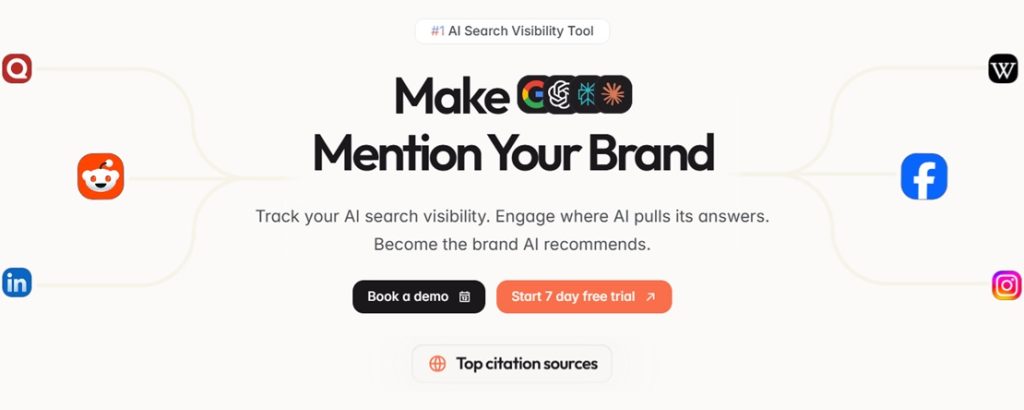
Quick honesty check before I go further: I run CrowdReply, so read this section with an extra pinch of salt and go run your own trial.
CrowdReply is the operating system for AI search visibility built around closing the loop. It tracks how AI models mention you, then puts the fix right next to the problem. That is the exact piece I wanted from Otterly and did not get, and that’s why I ranked CrowdReply #1.
What stood out for me was the action layer. When I found a prompt where a competitor was cited and I was not, I was not sent off to solve it in four other tabs.
The Backlinks Marketplace let me order vetted editorial placements from a catalog of 40,000-plus publishers, filtered by domain rating, traffic, country and citation rate. The Engagement Engine puts your brand into the conversations AI actually reads and the Brand Knowledge Fixer goes after the spots where models get your facts wrong.
CrowdReply tracks daily, does competitor and sentiment tracking on every tier and gives you MCP plus API access even on the cheapest plan. My setup was fast and I had a useful read on my own brand inside the first session.
Pros
- The only tool on this list that pairs tracking with a built-in fix path, backlinks, content, knowledge fixes and engagement instead of stopping at the chart.
- The $99 entry undercuts most trackers and still includes the action layer plus daily tracking.
- Competitor tracking, historical data and engagement credits come on the entry plan, not gated to higher tiers.
- MCP and API on every tier.
Cons
- It is newer than the incumbents, and the category itself is still young.
- If all you want is a read-only dashboard to screenshot for a board deck, you will underuse half of it. The action layer is the point, and if you are not going to act, you are paying for capability you will not touch.
Pricing
- Starter, $99/mo: 1 brand, 20 prompts, 2 of 7 models, the Backlinks Marketplace and $50 in monthly engagement credits.
- Growth, $299/mo: 3 brands, 75 prompts, 4 models, unlimited seats and $200 in credits.
- Enterprise, from $499/mo: 10 brands, 200 prompts, all 7 models and $300 in credits.
- 7-day free trial and a 30-day money-back guarantee. The $99 entry sits well above Otterly’s $29, but it includes the fixing layer, not just the tracking.
My verdict
- ✓ if you will actually work the gaps the tool surfaces.
- ✗ if you only need a monitoring dashboard and nothing more.
2. Profound, best for enterprise and data depth
Profound is the polished enterprise pick and the tool I would point a big-company buyer to when data depth matters more than price.
The standout for me was Agent Analytics, server-side tracking feature that captures how AI crawlers actually hit your site. That’s something client-side tools miss entirely.
The data is the deepest I saw and the reporting is clean enough to drop straight into an exec deck. Profound runs on a huge index of real conversations and it is heavily funded and backed by Sequoia, so it is not going anywhere.
Here is the catch on price: the $99 Starter tracks ChatGPT only. Real multi-engine coverage starts at the $399 Growth plan and the newer action features are less mature than the reporting.
Pros
- The deepest, cleanest data in the category, plus server-side bot tracking others do not have.
- Executive-ready reporting across citations, competitors, traffic and sentiment.
- SOC 2 and SSO for procurement-heavy buyers.
Cons
- The $99 Starter is ChatGPT-only, so real coverage means jumping to $399.
- Every self-serve plan is capped on Agent credits, and the broadest engine coverage is Enterprise-only.
- Analytics-led. The action side, Projects and Aim, is newer and still catching up to the reporting.
Pricing
- Starter, $99/mo (billed yearly): ChatGPT only, 50 prompts.
- Growth, $399/mo: 3 engines, 100 prompts, daily tracking.
- Enterprise, custom: up to about 9 engines, SSO and SOC 2.
My verdict
- ✓ if you are enterprise and price is not the deciding factor.
- ✗ if you are a lean team that needs multi-engine coverage without jumping to $399.
3. AthenaHQ, best for model coverage plus a content agent
As I said in my article on the best Scrunch AI alternatives, AthenaHQ is the tool that feels closest to tracking with a brain. It watches nine models on the paid plan, which is more coverage than most tools give you at any price, and it comes from an ex-Google and DeepMind team.
What I liked is that it does not just show a gap; it drafts a fix through its content optimization agent, and it connects to GA4, Search Console and Shopify so you can tie AI visibility to actual revenue. There is a genuinely free Essential tier too, which is the cheapest way to see your own numbers before you spend a cent.
The thing to watch is the credit model. One credit equals one AI response, so multi-engine plus multi-region plus daily sampling burns credits faster than you expect. Moreover, $295 a month is a real commitment before you have proven a return.
Pros
- Nine-model coverage plus a content optimization agent built in, not bolted on.
- GA4, Search Console and Shopify integrations connect visibility to revenue.
- Free Essential tier to start and a credible founding team.
Cons
- Credit math is hard to forecast once you turn on real tracking.
- The $295 Starter is steep for lean teams, and the credit bucket can feel tight at volume.
- API access and extra credits are add-ons billed on top.
Pricing
- Essential, free: 300 credits, 4 to 5 models.
- Starter, $295/mo: 3,600 credits, 9 models, content agent.
- Enterprise, custom: Citation Engine, SSO and white-glove setup.
My verdict
- ✓ if broad model coverage and built-in recommendations are your priority.
- ✗ if unpredictable credit spending would keep you up at night.
4. Peec AI, best for clean reporting and unlimited seats
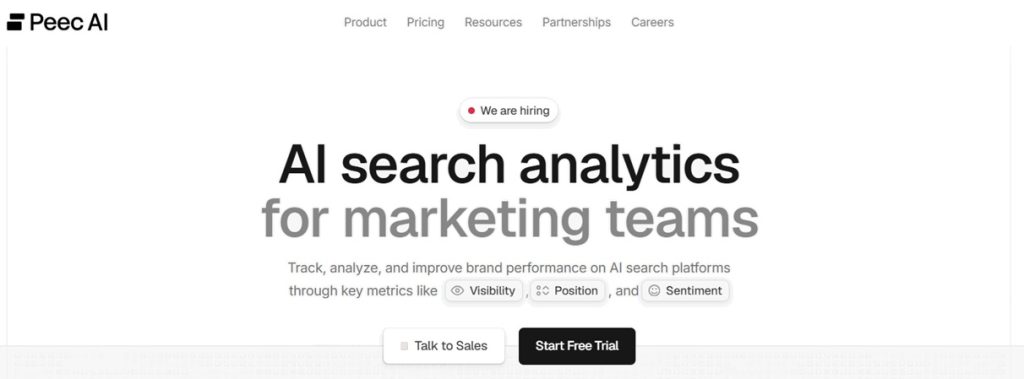
Peec AI is the tool I would hand an agency that lives in client reporting all day. It was also the alternative I saw recommended most often by other people who had left Otterly.
What won me over was how fast it was to learn and how it treats seats. Every plan gives you unlimited users, which for an agency is a bigger deal than it sounds.
Peec AI handles languages and regions well, keeps its data in the EU, and the suggested prompts and gap-analysis features save you from staring at a blank tracking list. It also raised a big Series A in 2025, so there is some momentum behind it.
The honest limits are the same ones that pushed me off most rank trackers. It will not go discover where you already get mentioned and it shows the gap without helping you close it. Add-on engines beyond the base three also climb the bill.
Pros
- Clean, fast-to-learn interface with unlimited seats on every plan.
- Reasonable entry near $95 a month, with strong multi-language and multi-country coverage plus EU data residency.
- Suggested prompts and gap analysis make content research easier.
Cons
- Manual prompt entry, with no auto-discovery of where you already appear.
- Monitoring only, so it will not build authority or fix anything for you.
- Add-on engine costs climb past the base three, from $30 to $140 a month per extra model, and the API is Enterprise-only.
Pricing
- Starter, about $95/mo (roughly $80 billed annually): 50 prompts, 3 models, unlimited seats.
- Pro, about $245/mo: 150 prompts, 2 projects.
- Advanced, about $495/mo: 350 prompts, multi-country and Looker Studio.
My verdict
- ✓ if you want simple, shareable reporting across a lot of seats.
- ✗ if you need broad engine coverage or a fixing workflow.
5. Scrunch AI, best for brand safety and an agent-delivery layer
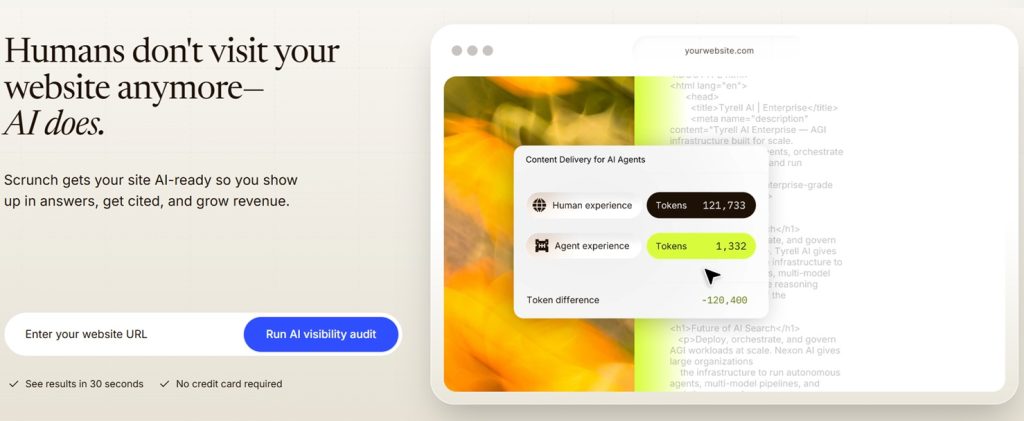
Scrunch AI is the one with a genuinely different idea, and it is the tool I would look at if serving AI crawlers a clean version of your pages were the job.
Its Agent Experience Platform detects AI agents hitting your site and serves them a lightweight, machine-readable version of your content, so the models retrieve it for you more cleanly. Nobody else on this list does that.
Scrunch also gives you an AI bot and agent traffic feed alongside the usual citation tracking and now has a self-serve Core plan rather than sales-gated-only pricing.
Two honest catches: Scrunch was acquired by Sitecore in mid 2026 for a reported $225 million and it is folding into Sitecore’s larger platform, so the standalone $250 plan and roadmap are worth confirming directly before you commit. Additionally, the AXP layer plus the broader engines (you know, the good parts!) live in Enterprise and need engineering time to turn on.
Pros
- The Agent Experience Platform is a real, differentiated idea no pure monitor on this list matches.
- A live AI bot and agent traffic feed, plus persona, topic and geography competitor analysis.
- Now has a published self-serve Core plan with a 7-day trial, no card.
Cons
- The engines you want, Claude, Gemini and Google AI Mode, plus multi-domain tracking and API access, are all Enterprise-only. Core is four engines and one workspace.
- A $250 floor with no free tier and nothing cheaper underneath.
- Getting the real value out of the AXP layer needs engineering lift, not a marketer self-serve setup.
Pricing
- Core, $250/mo: 125 prompts, 4 engines, 1 brand, 5 seats, 7-day trial. Worth confirming directly given the Sitecore acquisition.
- Enterprise, custom: 9 engines, the Agent Experience Platform, multi-domain tracking and API access.
My verdict
- ✓ if the crawler-delivery angle is your priority and you can fund the Enterprise tier.
- ✗ if you want cheap, self-serve, broad coverage out of the box.
6. Semrush AI Toolkit, best for teams already in Semrush
Semrush’s AI Toolkit is the sensible pick if your team already runs its SEO inside the platform and you want AI visibility bolted onto the same login instead of buying a separate specialist tool.
What you get is brand tracking in AI answers, AI sentiment and custom-prompt monitoring, sitting right next to the keyword research, position tracking and site audit you already pay for. There is even a free AI Visibility Checker to sample before you commit.
One thing worth knowing, though: Semrush is now an Adobe company (Adobe closed its roughly $1.9 billion acquisition in April 2026), so expect the roadmap to shift over time.
The main trade-off is depth. The specialist trackers go deeper on daily prompt volume and engine coverage and real AI search coverage effectively starts at the $199 tier once you want more than the baseline. It’s an SEO suite first, so there is no AI-specific execution layer.
Pros
- AI visibility is now built into the suite most SEO teams already pay for, one login and one bill.
- Backed by Semrush’s mature data, reporting and integrations, with a free AI Visibility Checker to sample.
- Baseline AI-visibility reporting shows up even on the entry SEO tier.
Cons
- Specialist AI-visibility depth trails purpose-built trackers on prompt volume and engine coverage.
- Real AI-search coverage effectively starts at the $199 tier, and heavier volumes push you to $299 or more.
- It is an SEO suite first, with no content or outreach execution layer for AI visibility specifically.
Pricing
- SEO, $139/mo: the SEO core plus baseline AI-visibility tracking.
- Starter (SEO + AI Search), $199/mo: 50 prompts daily, an AI-ready site audit and MCP access.
- Pro+, $299/mo and Advanced, $549/mo: more sites, keywords and daily prompts.
My verdict
- ✓ if you already pay for Semrush.
- ✗ if you want specialist AI-tracking depth or a dedicated fixing layer.
7. Writesonic, best for content teams
Writesonic started as an AI writer and grew into a GEO tool. Therefore, it’s the natural pick if your team’s center of gravity is content.
It pairs visibility tracking with an Action Center that tells you what to create and where to reach out, plus an article writer and an SEO editor. Consequentially, you can spot a gap and draft something to fill it in the same place.
GEO tracking is on every tier now, and it ties into your GSC, GA4 and CRM data. That track-to-write-to-act loop is a genuine step past a plain dashboard.
The trade-off is that the depth makes setup feel busy, and the full execution layer is effectively Enterprise. On the self-serve plans the Action Center is more of a taste than the full meal, and you only get three engines until you go up.
Pros
- Track-to-write-to-act in one tool, and the Action Center is a real step beyond a chart.
- GEO tracking on every tier now, connected to established SEO and search data.
- Affordable entry at $79 a month annual, with a no-card trial.
Cons
- The feature depth makes setup feel complex, especially if you are new to GEO.
- The full Action Center execution layer is effectively Enterprise.
- Self-serve tiers track only three engines, and the AI writing still needs a human editor before anything ships.
Pricing
- Starter, $79/mo (annual): 3 engines, 50 prompts, 15 AI articles a month.
- Basic, $199/mo: 100 prompts, 25 articles, 2 users.
- Growth, $399/mo: 200 prompts, sentiment, an Action Center trial, 50 articles.
My verdict
- ✓ if content is your center of gravity and you want writing built in.
- ✗ if you want a focused tracker without the extra suite around it.
8. Ahrefs Brand Radar, best for search-backed research
Ahrefs Brand Radar is the research-grade option, and it is the one I would reach for to study the whole category, not just my own brand. Brand Radar’s main edge is scale, as it runs on a database of 476M-plus search-backed prompts modeled on real search behavior.
You can query any brand, topic or vertical instantly with zero setup and get mentions, citations, impressions and AI share of voice. It even tracks Reddit, YouTube and TikTok visibility that most GEO tools ignore, which matters because that is where a lot of AI answers get sourced.
The limit is that it is built for research, not operations. It will not run a content or outreach workflow for you, and the pricing has climbed.
Pros
- A search-backed prompt universe of 476M plus that others cannot match, with zero setup.
- Strong for competitive research, and it tracks Reddit, YouTube and TikTok sources most tools skip.
- Cost-effective and familiar if you already live inside Ahrefs.
Cons
- Research-oriented, so it will not run content or outreach for you.
- Pricing has climbed, and tracking every platform gets expensive.
- Best value only really lands if you are already an Ahrefs customer.
Pricing
- Select platforms, $398/mo: choose the AI platforms you want to track.
- All platforms, $699/mo: the full 476M plus prompt database plus custom-prompt checks.
- Available alongside Ahrefs subscriptions, with a free demo.
My verdict
- ✓ if you want market-wide research and already use Ahrefs.
- ✗ if you need a daily operational tracker with a fixing layer.
Still don’t know what the best Otterly AI alternative for your team is?
Based on everything I learned while testing these tools, this is the gist of it:
- I’m a mid-market team that needs to move the number: CrowdReply.
- I’m an enterprise looking for data depth: Profound.
- I really need the widest model coverage in the market: AthenaHQ.
- I’m looking for clean reporting across unlimited seats: Peec AI.
- I’m all about brand safety and have the required engineering resources: Scrunch AI.
- I’m already on Semrush: AI Toolkit.
- I’m essentially a content team, but I’m also looking for tracking: Writesonic.
- I’m already on Ahrefs: Brand Radar.
Pick the one your team will use, then commit to acting on it for a quarter. Run your real prompts through two of them before you decide.
What you should do next:
The category really splits into two camps, watch it and move it. Pick the side that matches whether you will actually act on what you see, as the fanciest tracker in the world is wasted if the gap it finds just sits there.
Do not overthink the feature grid. Run a real prompt set through two tools on the same brand and see which one gets you to a useful, actionable read the fastest.
If you want the version that closes the loop instead of just charting it, start a CrowdReply trial and point it at your own brand.
Frequently asked questions
What is the best Otterly AI alternative?
CrowdReply is the best for most mid-market teams, Profound is the stronger pick if you are enterprise and need the deepest data and Peec AI wins if you want clean reporting across a lot of seats on the tightest reasonable budget.
How much does Otterly AI cost, and is the $29 plan actually usable?
Otterly starts at $29 a month for the Lite plan, but that buys just 15 prompts across four engines, which is really a trial in disguise. Real day-to-day use starts at the $189 Standard plan, and because extra engines and prompt blocks are billed as add-ons, the true cost is usually higher than the tier you signed up for.
Are there cheaper or free Otterly AI alternatives?
Yes. AthenaHQ has a genuinely free Essential tier with 300 credits, which is the cheapest way to see your own numbers before paying anything. Writesonic starts at $79 a month and Peec AI lands near $95.
Peec AI vs Otterly: which should I pick?
Peec AI for clean, multi-language reporting with unlimited seats; Otterly for the cheapest possible single-seat start.
Profound vs Otterly AI: which is better?
Profound for enterprise data depth and server-side traffic attribution, with reporting clean enough for an exec deck. Otterly is better for a cheaper, simpler start. Profound is built for big teams that want the deepest data, while Otterly is built for a solo marketer who wants a quick, affordable read.
Which alternatives track Claude, and which gate Gemini or AI Mode behind add-ons?
Otterly ships four base engines and charges extra for Gemini and Google AI Mode, with no self-serve Claude at all. If broad model coverage matters, AthenaHQ tracks nine models including Claude, CrowdReply covers up to seven and Peec reaches Claude and more at its top tier.
What is the biggest mistake teams make when switching from Otterly?
Chasing the longest feature list instead of a tight prompt set tied to a business outcome. Pick from the handful of prompts you will actually act on, get a clean baseline and only then commit to working the gaps for a quarter.