TL;DR
- CrowdReply is the overall best Scrunch AI alternative, especially if you want to improve your AI visibility (not just watch it).
- Profound is the obvious alternative for enterprise-level projects.
- AthenaHQ is not perfect, but it gives you the widest model coverage.
- Peec AI stands as the best Scrunch AI alternative if clean reporting is your priority.
- Otterly is impressive because of its super low price (a great option for freelancers running on a tight budget).
- Semrush AI Toolkit is the obvious alternative if you’re already paying for Semrush.
- Writesonic is the Scrunch AI alternative I suggest to teams dealing mainly with written content.
- Brand Radar if you already live in Ahrefs (similar to the Semrush AI Toolkit).
I have personally tested the 8 tools that everyone keeps citing as the best Scrunch AI alternatives. This article is about what I found out, and the whole point is to help you select the tool that works best for your specific needs.
Before the list of the best tools, though, it’s important to understand what Scunch AI actually is, considering both its qualities and the gaps that have forced me to go look for an alternative.
What Scrunch AI actually is (and why it’s not that bad)
Let me be fair to Scrunch before I start poking at it, because most of the posts out there rush past the incumbent on their way to selling you something else.
Scrunch AI is an AI search visibility platform out of Salt Lake City, founded in 2023 by Chris Andrew. It watches how your brand shows up across ChatGPT, Perplexity, Google AI Overviews and Copilot, tracks your citations and sentiment, and shows you which sources the models pull from.
It is a real company with real money behind it. It raised a $15M Series A led by Decibel in July 2025, bringing it to about $19M raised in total.
Here is the part I actually liked: Scrunch does one thing no other tool on this list does.
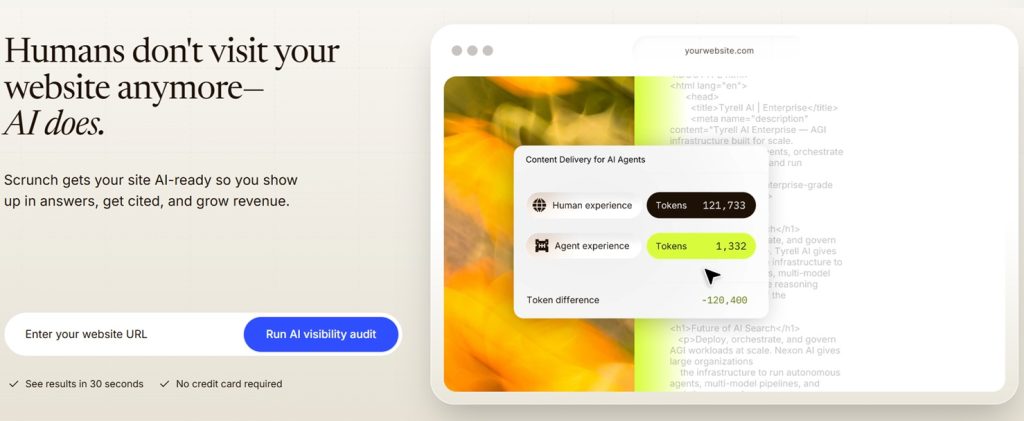
Alongside the normal tracking, it runs an Agent Experience Platform that detects AI crawlers hitting your site and serves them a clean, machine-readable version of your pages. It is a genuinely different idea, and for a technical team it is the main reason to look at Scrunch.
The rest is solid too. The enterprise posture is real, with SOC 2 Type II, single sign-on and a forward-deployed engineer on the top plan. Finally, it has a self-serve Core plan at $250 a month with a 7-day trial, so you do not have to book a sales call just to see it.
The reason any of this matters is… money. By 2028, McKinsey expects $750 billion in US revenue to move through AI-powered search. Being named in the answer is the new being on page one.
What Scrunch’s Agent Experience Platform actually does
This deserves its own section because it is the most interesting thing Scrunch built and the competitors mostly ignore it. Here is the plain version: when an AI crawler like GPTBot or PerplexityBot hits your site, it does not read the page the way a person does.
The Agent Experience Platform spots that the visitor is a bot and serves it a stripped-down, machine-readable version of your content. You keep the pretty page for humans and hand the bot the clean one, so the model retrieves you more cleanly.
I saw it work. When I pointed a crawler at Scrunch’s own site, the platform caught that it was an agent and served it a different, transformed version of the page than the one my browser got. It is a neat trick and it is real.
The honest caveat is that nobody outside Scrunch has proven it moves citation share yet. It is an early idea with a strong pitch, not a settled best practice.
If that delivery angle is what you want, a few tools touch the same ground from different directions. Profound’s Agent Analytics tracks how AI crawlers hit your site server-side, Writesonic has AI Bot Analytics and Ahrefs Brand Radar shows you which sources the models actually cite.
None of them serve the bot a custom page the way Scrunch does, but they all get you closer to how the crawlers actually see you than a plain prompt tracker.
Why I went looking for a Scrunch AI alternative
You can already tell that this is not a “Scrunch is bad” article. The AXP idea is very smart, for example. The problem is that everything around it stopped short of what I needed, and then the ground moved under the whole product. Here is what pushed me to keep trialing other tools:
1 – It just got acquired, and that changes the math
This is the big one. In June 2026, Sitecore acquired Scrunch for a reported $225 million. Scrunch is folding into Sitecore’s larger digital experience platform.
That is a good outcome for the founders, but it’s a murkier one for a small buyer. When a standalone tool gets absorbed into a suite, the pricing, the roadmap and the self-serve plan all become open questions. I do not want to build my AI visibility workflow on a product that might get repackaged as an enterprise DXP add-on next quarter.
2 – It shows you the gap without closing it
Scrunch is good at telling you where you stand, but it is much weaker at helping you do anything about it. The insights and site audits still feel like a beta, and the guidance reads vague.
In one audit during testing I got a 100% score and a flagged issue on the same screen, with no clear instruction on what to actually fix. I do not want a tool that finds the problem and then hands the whole fix back to me.
3 – You need an engineer to get the good part
The AXP layer, the part that makes Scrunch special, is not a marketer self-serve setup. It needs real technical implementation to deliver. If you do not have engineering time to give it, you are paying for a headline feature you cannot fully turn on.
4 – The engines you want are locked upstairs
The Core plan tracks four engines and one brand. Claude, Gemini, Google AI Mode and Grok, plus multi-domain tracking and API access, all live at Enterprise. For $250 a month I expected more than four engines and a single workspace.
5 – The floor is high and there is nothing below it
Scrunch starts at $250 a month with no free tier and nothing cheaper underneath. Meanwhile, AthenaHQ gives you a free plan to start and Otterly starts at a mere $29. Paying $250 before you have proven a return is a real ask for a lean team.
There is also the plain fact that AI answers move around. One controlled 2026 study found that re-asking the same prompt accounted for about 35% of the variance in what came back. A single snapshot is closer to noise than signal, so any tracker needs to sample a lot before you trust it, and Scrunch’s history window is on the shorter side.
What actually matters in a Scrunch AI alternative
After running the whole set through the same prompts, one question predicted whether I would be happy more than any spec sheet: does the tool just watch, or does it help you act?
Monitoring versus action
Almost every product in this category works well as an AI search monitoring tool. Brand mentions, citations, competitor share of voice, sentiment… That part is table stakes and Scrunch does it fine.
The thing that separates them is what happens next. Most stop at the dashboard and leave the work to you, but a few connect the gap to an actual workflow, content, backlinks and corrections (in other words, the moves that shift your citation share).
That unsolved half is the whole game, and hardly anyone is even measuring it. Only about 16% of brands systematically track their AI search performance, per McKinsey. Fixing it is even rarer.
This matters because readers have stopped clicking, as shown by Pew Research:
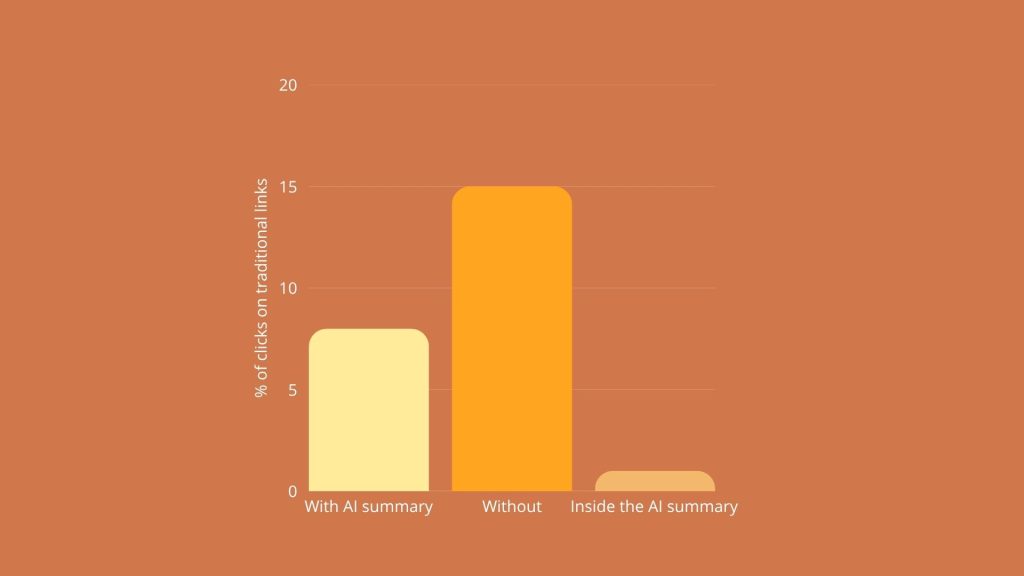
When Google shows an AI summary, people click a regular link about 8% of the time versus 15% when there is no summary. The bottom line? If you are not in the answer, you are nowhere.
The boring (but important) stuff I checked
Past that split, it’s all about:
- Pricing you can actually predict.
- Real engine coverage (does it track AI Overviews and AI Mode, or does it just say “AI”?).
- Seats and agency fit.
- Sentiment and competitor tracking.
- How fast I got to a useful read.
Summary of the 8 best Scrunch AI alternatives
Before the deep dives, here is the quick version (prices are entry-tier, monthly):
| Tool | Best for | Entry price | Pricing model | Engines at entry | Action layer | Free trial |
|---|---|---|---|---|---|---|
| CrowdReply | Teams that need to move the number, not just watch it | $99 | Flat tiers + credits | 2 of 7 (up to all 7) | Yes, built in | 7 days |
| Profound | Enterprise and data depth | $99 | Flat tiers | 1 (ChatGPT) | Light, growing | Yes |
| AthenaHQ | Model coverage plus a content agent | Free / $295 | Credit-based | 4 free, 9 paid | Recommendations | Free tier |
| Peec AI | Clean reporting and unlimited seats | $95 | Flat tiers + add-ons | 3 of 6 | No | Yes |
| Otterly AI | The tightest budget | $29 | Flat tiers + add-ons | 4 | No | Yes |
| Semrush AI Toolkit | Teams already in Semrush | $139 | Suite tiers | 5, in the suite | Via the suite | Yes |
| Writesonic | Content teams that want to track AND write | $79 | Flat tiers | 3 (up to 10) | Action Center | Yes, no card |
| Ahrefs Brand Radar | Search-backed research | $398 | Flat tiers | 7, database-wide | Research only | Demo |
What I learned after testing each Scrunch AI alternative
I ranked these by who I would actually hand each one to, not by how big the brand is. Here is what every tool does well and where it bit me:
1. CrowdReply, best for teams that will act on the data
CrowdReply is the tool I would hand most mid-market teams first. Quick honesty check before I go further: I actually run it, so read this section with an extra pinch of salt and go run your own trial.
CrowdReply is the operating system for AI search visibility that was actually built around closing the loop. It tracks how AI models mention you, then puts the fix right next to the problem. That is the exact piece I wanted from Scrunch and did not get.
What stood out for me was the action layer. When I found a prompt where a competitor was cited and I was not, I was not sent off to solve it in four other tabs.
The Backlinks Marketplace let me order vetted editorial placements from a catalog of 40,000+ publishers, filtered by domain rating, traffic, country and citation rate. The Engagement Engine puts your brand into the conversations AI actually reads and the Brand Knowledge Fixer goes after the spots where models get your facts wrong.
CrowdReply tracks daily, does competitor and sentiment tracking on every tier and gives you MCP plus API access even on the cheapest plan. My setup was fast and I had a useful read on my own brand inside the first session.
Pros
- The only tool on this list that pairs tracking with a built-in fix path, backlinks, content, knowledge fixes and engagement instead of stopping at the chart.
- The $99 entry undercuts most trackers and still includes the action layer plus daily tracking.
- Competitor tracking, historical data and engagement credits come on the entry plan, not gated to higher tiers.
- MCP and API on every tier, so it drops into your own stack.
Cons
- It is newer than the incumbents (anyway, the category itself is still young).
- If all you want is a read-only dashboard to screenshot for a board deck, CrowdReply can be overkill. The action layer is the point, and if you are not going to act, you are paying for capability you will not touch.
Pricing
- Starter, $99/mo: 1 brand, 20 prompts, 2 of 7 models, the Backlinks Marketplace and $50 in monthly engagement credits.
- Growth, $299/mo: 3 brands, 75 prompts, 4 models, unlimited seats and $200 in credits.
- Enterprise, from $499/mo: 10 brands, 200 prompts, all 7 models and $300 in credits.
- 7-day free trial and a 30-day money-back guarantee. The $99 entry beats Scrunch’s $250 floor and includes the fixing layer, not just the tracking.
Best for: mid-market B2B SaaS growth and SEO leads who need to move their AI visibility number, not just report on it.
Yes, if you will actually work the gaps that the tool surfaces. No, if you only need a monitoring dashboard and nothing more.
2. Profound, best for enterprise and data depth
Profound is the polished enterprise pick, and it is the tool I would point a big-company buyer to when data depth matters more than price.
The standout for me was Agent Analytics, a feature that provides server-side tracking that captures how AI crawlers actually hit your site, which client-side tools tend to miss entirely. If you liked the crawler angle in Scrunch’s AXP, this is the closest analytics equivalent.
The data is the deepest I saw, and the reporting is clean enough to drop straight into an exec deck. It runs on a huge index of real conversations, and it is well funded, so it is not going anywhere.
Here is the catch on price: the $99 Starter tracks ChatGPT only. Moreover, real multi-engine coverage starts at the $399 Growth plan and the newer action features are less mature than the reporting.
Pros
- The deepest, cleanest data in the category, plus server-side bot tracking others do not have.
- Executive-ready reporting across citations, competitors, traffic and sentiment.
- SOC 2 and SSO for procurement-heavy buyers.
Cons
- The $99 Starter is ChatGPT-only, so real coverage means jumping to $399.
- Every self-serve plan is capped on Agent credits, and the broadest engine coverage is Enterprise-only.
- Analytics-led. The action side is new and still catching up to the reporting.
Pricing
- Starter, $99/mo (billed yearly): ChatGPT only, 50 prompts.
- Growth, $399/mo: 3 engines, 100 prompts, daily tracking.
- Enterprise, custom: up to about 9 engines, SSO and SOC 2.
Best for: enterprise and regulated teams where data depth and reporting polish are the buying criteria.
Yes, if you are enterprise and price is not the deciding factor. No, if you are a lean team that needs multi-engine coverage without jumping to $399.
3. AthenaHQ, best for model coverage plus a content agent
AthenaHQ was the one that felt closest to “tracking with a brain.” It watches nine models on the paid plan, which is more coverage than most tools give you at any price and it comes from an ex-Google and DeepMind team.
What I liked is that it does not just show a gap, it drafts a fix through its content optimization agent, and it connects to GA4, Search Console and Shopify so you can tie AI visibility to actual revenue. There is a free Essential tier too, which is the cheapest way to see your own numbers before you spend.
The thing to watch is the credit model. One credit equals one AI response, so multi-engine plus multi-region plus daily sampling burns credits faster than you expect, and $295 a month is a real commitment before you have proven a return. It lacks an action layer too, and that’s what made me look for AthenaHQ alternatives before, but it does fix some of Scrunch’s gaps.
Pros
- Nine-model coverage plus a content optimization agent built in, not bolted on.
- GA4, Search Console and Shopify integrations connect visibility to revenue.
- Free Essential tier to start and a credible founding team.
Cons
- Credit math is hard to forecast once you turn on real tracking.
- The $295 Starter is steep for lean teams, and the credit bucket can feel tight at volume.
- API access and extra credits are add-ons billed on top.
Pricing
- Essential, free: 300 credits, 4 models.
- Starter, $295/mo: 3,600 credits, 9 models, content agent.
- Enterprise, custom: Citation Engine, SSO and white-glove setup.
Best for: mid-market and enterprise teams that want reporting rigor plus a recommendation agent, and value the Google pedigree.
Yes, if broad model coverage and built-in recommendations are your priority. No, if unpredictable credit spending would keep you up at night.
4. Peec AI, best for clean reporting and unlimited seats
Peec AI is the clean, European pick, and it is the tool I would hand an agency that lives in client reporting all day.
What won me over was how fast it was to learn and how it treats seats. Every plan gives you unlimited users, which for an agency is a bigger deal than it sounds. It handles languages and regions well, keeps its data in the EU and offers suggested prompts and gap-analysis features that save you from staring at a blank tracking list.
The honest limits are the same ones that pushed me off most trackers. You hand-enter your prompts, meaning it will not go discover where you already get mentioned and it shows the gap without helping you close it. Add-on engines beyond the base three also climb the bill.
Pros
- Clean, fast-to-learn interface with unlimited seats on every plan.
- Reasonable entry at $95 a month, with strong multi-language and multi-country coverage plus EU data residency.
- Suggested prompts and gap analysis make content research easier.
Cons
- Manual prompt entry, with no auto-discovery of where you already appear.
- Monitoring only, so it will not build authority or fix anything for you.
- Add-on engine costs climb past the base three, and the API is Enterprise-only.
Pricing
- Starter, $95/mo (about $80 annual): 50 prompts, 3 models, unlimited seats.
- Pro, $245/mo: 150 prompts, 2 projects.
- Advanced, $495/mo: 350 prompts, multi-country and Looker Studio.
Best for: mid-market marketing teams and agencies that want clean reporting with unlimited seats and strong multi-language coverage.
Yes, if you want simple, shareable reporting across a lot of seats. No, if you need broad engine coverage or a fixing workflow.
5. Otterly AI, best for the tightest budget
With Lite at $29/mo, Otterly is the cheapest real way into AI mention tracking, full stop.
For that you get 15 prompts across four engines, ChatGPT, Google AI Overviews, Perplexity and Copilot, with unlimited members, daily tracking and a batch of GEO URL audits included. The pricing is published and transparent, which I appreciate more every time a competitor makes me book a demo just to learn a number.
Two honest caveats: the four engines are the base, and AI Mode, Gemini and Claude are paid add-ons (so the real multi-engine price climbs) and 15 prompts is thin, so you will graduate to the $189 Standard plan quickly if you get serious.
Pros
- The lowest entry price in the category, with transparent published pricing.
- Unlimited members on every plan, plus daily tracking and GEO URL audits.
- Clean, fast interface and coverage across 50-plus countries.
Cons
- Only four engines at base, and AI Mode plus Gemini and Claude cost extra.
- Just 15 prompts on the Lite tier.
- Monitoring first, with no action or content layer.
Pricing
- Lite, $29/mo: 15 prompts, 4 engines, 1,000 GEO audits.
- Standard, $189/mo: 100 prompts, API and MCP access, 5,000 audits.
- Premium, $489/mo: 400 prompts, 10,000 audits.
Best for: solo marketers and small teams who want simple monitoring for the price of a couple of coffees a week.
Yes, if your budget is tight and you want honest, published pricing. No, if you need broad engine coverage or any kind of fixing workflow.
6. Semrush AI Toolkit, best for teams already in Semrush
Semrush is the sensible pick if your team already runs its SEO inside the platform and you want AI visibility bolted onto the same login instead of buying a separate specialist tool.
In 2026, Semrush folded AI visibility into its main suite. You get brand tracking in AI answers, AI sentiment and custom-prompt monitoring, sitting right next to the keyword research, position tracking and site audit you already pay for. There is even a free AI Visibility Checker to sample before you commit.
The trade-off is depth. The specialist trackers go deeper on daily prompt volume and engine coverage, and real AI search coverage effectively starts at the $199 Starter tier once you want more than the baseline. It is an SEO suite first, so there is no AI-specific execution layer.
Pros
- AI visibility is now built into the suite most SEO teams already pay for, one login and one bill.
- Backed by Semrush’s mature data, reporting and integrations, with a free AI Visibility Checker to sample.
- Baseline AI-visibility reporting shows up even on the entry SEO tier.
Cons
- Specialist AI-visibility depth trails purpose-built trackers on prompt volume and engine coverage.
- Real AI-search coverage effectively starts at the $199 tier, and heavier volumes push you to $299 or more.
- It is an SEO suite first, with no content or outreach execution layer for AI visibility specifically.
Pricing
- SEO, $139/mo: the SEO core plus baseline AI-visibility tracking.
- Starter (SEO + AI Search), $199/mo: 50 prompts daily, AI-ready site audit and MCP access.
- Pro+, $299/mo and Advanced, $549/mo: more sites, keywords and daily prompts.
Best for: teams already living in Semrush who want AI visibility added to their existing SEO stack.
Yes, if you already pay for Semrush and want one less tool. No, if you want specialist AI-tracking depth or a dedicated fixing layer.
7. Writesonic, best for content teams
Writesonic started as an AI writer and grew into a generative engine optimization tool, so it is the natural pick if your team’s center of gravity is content.
Writesonic pairs visibility tracking with an Action Center that tells you what to create and where to reach out, plus an article writer and an SEO editor. You can spot a gap and draft something to fill it in the same place.
GEO tracking is on every tier now, and it ties into your GSC, GA4 and CRM data. That track-to-write-to-act loop is a genuine step past a plain dashboard.
The trade-off is that the depth makes setup feel busy, and the full execution layer is effectively Enterprise. On the self-serve plans, the Action Center is more of a taste than the full meal.
Pros
- Track-to-write-to-act in one tool, and the Action Center is a real step beyond a chart.
- GEO tracking on every tier now, connected to established SEO and search data.
- Affordable entry at $79 a month annual, with a no-card trial.
Cons
- The feature depth makes setup feel complex, especially if you are new to GEO.
- The full Action Center execution layer is effectively Enterprise.
- The AI writing still needs a human editor before anything ships.
Pricing
- Starter, $79/mo (annual): 3 engines, 50 prompts, 15 AI articles a month.
- Basic, $199/mo: 100 prompts, 25 articles, 2 users.
- Growth, $399/mo: 200 prompts, sentiment, an Action Center trial, 50 articles.
Best for: content marketing teams and agencies that want to monitor and write to close gaps in one place.
Yes, if content is your center of gravity and you want writing built in. No, if you want a focused tracker without the extra suite around it.
8. Ahrefs Brand Radar, best for search-backed research
Ahrefs Brand Radar is the research-grade option, and it is the one I would reach for to study the whole category, not just my own brand.
Its edge is scale, as it runs on a database of 476M+ search-backed prompts modeled on real search behavior. You can query any brand, topic or vertical instantly with zero setup and get mentions, citations, impressions and AI share of voice.
Brand Radar even tracks Reddit, YouTube and TikTok visibility that most GEO tools ignore, which matters because that is where a lot of AI answers get sourced.
The limit is that it is built for research, not operations. It will not run a content or outreach workflow for you, and the pricing has climbed.
Pros
- A search-backed prompt universe of 476M+ that others cannot match, with zero setup.
- Strong for competitive research, and it tracks Reddit, YouTube and TikTok sources most tools skip.
- Cost-effective and familiar if you already live inside Ahrefs.
Cons
- Research-oriented, so it will not run content or outreach for you.
- Pricing has climbed, and tracking every platform gets expensive.
- Best value only really lands if you are already an Ahrefs customer.
Pricing
- Select platforms, $398/mo: choose the AI platforms you want to track.
- All platforms, $699/mo: the full 476M+ prompt database plus custom-prompt checks.
- Available alongside Ahrefs subscriptions, with a free demo.
Best for: SEO teams, especially existing Ahrefs customers, who want AI visibility research at real data scale.
Yes, if you want market-wide research and already use Ahrefs. No, if you need a daily operational tracker with a fixing layer.
How to pick the right Scrunch AI alternative for your team
For the default mid-market B2B SaaS team that needs to move the number and not just watch it, I would start with CrowdReply. It is the one that turns a visibility gap into a fix without making you leave the tool.
From there, it is all about your specific edge:
- Enterprise, and data depth plus reporting polish is the priority? Profound.
- Want the widest model coverage with recommendations baked in? AthenaHQ.
- Agency that needs clean reporting across unlimited seats? Peec AI.
- Smallest possible budget to start? Otterly.
- Already paying for Semrush and want one less tool? Semrush AI Toolkit.
- Content teams that want to track plus write? Writesonic.
- Already deep in Ahrefs and want market-wide research? Brand Radar.
How to switch off Scrunch AI without losing your data
Migrating is mostly about your prompt set, not your dashboards. Here is the order I would do it in:
- Export your tracked prompts, brands and any site audits out of Scrunch. That prompt list is the real asset, and rebuilding it from scratch is the only genuinely annoying part of switching.
- Rebuild the exact same prompt set in the new tool. Same wording, same competitors. If the prompts match, your trend lines stay comparable across the move.
- Run both tools in parallel for two to four weeks. Expect the numbers to differ, because different tools sample differently and AI answers vary run to run. You are re-baselining, not finding a bug.
Finally, don’t forget to keep an eye out for transition emails, as Scrunch sits inside Sitecore. If the plan you signed up for changes, you want to hear it from your inbox, not from a surprise invoice.
How I tested these tools:
I focused on the 8 tools a team actually shortlists when it is leaving Scrunch AI: CrowdReply, Profound, AthenaHQ, Peec AI, Otterly, Semrush AI Toolkit, Writesonic and Ahrefs Brand Radar.
I judged each on five things: pricing you can predict, real engine coverage across ChatGPT, Perplexity, Gemini, AI Overviews and AI Mode, action capability beyond monitoring, dashboard usability and how fast I reached a useful read.
For each one I signed up where a trial existed, ran the same buyer-prompt set through it, worked the dashboard, walked the pricing tier by tier and noted where it frustrated me.
Every tool got judged against the same buyer profiles. The “best for” on each reflects where its strengths and weaknesses actually landed, not where its marketing says they do.
Frequently asked questions
What is the best Scrunch AI alternative?
For most teams it is CrowdReply, because it is the only tool in this set built around fixing your visibility gaps, not just charting them. Profound is the stronger pick if you are enterprise and need the deepest data and Otterly wins if your budget is under $50 a month.
Was Scrunch AI acquired?
Yes. In June 2026, Sitecore acquired Scrunch for a reported $225 million, and the product is folding into Sitecore’s digital experience platform.
How much does Scrunch AI cost?
Scrunch’s self-serve Core plan is $250 a month for 125 prompts across four engines with a 7-day trial. The Enterprise plan is custom and unlocks nine engines, the Agent Experience Platform, multi-domain tracking and API access.
Profound vs Scrunch AI, which is better for AEO?
Profound wins on server-side data depth, engine coverage at the top tier and reporting polish, while Scrunch’s edge is the Agent Experience Platform that serves optimized pages to AI crawlers. Pick Profound for enterprise reporting rigor and Scrunch if the crawler-delivery angle is your priority and you have engineering time.
Are there cheaper Scrunch AI alternatives, or a free one?
Yes. Otterly starts at $29 and Writesonic at $79 a month, both far below Scrunch’s $250 floor. AthenaHQ has a genuinely free Essential tier with 300 credits and four models, which is the cheapest way to see your own numbers before paying anything.
What is Scrunch’s Agent Experience Platform, and does it work?
The Agent Experience Platform detects AI crawlers hitting your site and serves them a lightweight, machine-readable version of your pages so the models retrieve them more cleanly.
Which Scrunch AI alternative is best for agencies?
Peec AI gives you unlimited seats on every plan, which is what saves you on client work, plus clean multi-language reporting. If you also want to act on the data across those clients, not just report it, CrowdReply’s multi-brand plans are built for running several brands from one place.